Block Resolution
When one tab opens the DB at a higher version while another still has it open at an older version, IndexedDB fires a blocked event and the new open request stays pending until all other connections are closed. async-idb-orm handles this automatically so you don’t have to coordinate tabs by hand.
What happens
- Tab A has the DB open at version 1.
- You deploy version 2; Tab B loads the new code and calls
idb(..., { version: 2 }). - The upgrade from 1 → 2 can’t run until every connection from Tab A is closed.
- IndexedDB blocks the open in Tab B and fires
blocked.
async-idb-orm uses a BroadcastChannel to talk between tabs:
- When Tab B is blocked, it tells Tab A to close its connection.
- Tab A finishes in-flight work, closes the connection.
- Tab B’s open completes, runs
onUpgrade, and opens the DB at version 2. - Tab B then tells Tab A to reopen the DB at version 2.
So all tabs end up on the new version without you writing tab-coordination logic.
Optional: reload old tabs
You can force very old tabs to reload (e.g. after breaking changes) via onBeforeReinit:
const VERSION = 1
export const db = idb("users", {
  schema,
  version: VERSION,
  onUpgrade: async (ctx, event) => {
    // handle migrations
  },
  onBeforeReinit: (oldVersion, newVersion) => {
    const breakingChangesVersion = parseInt(localStorage.getItem("breakingChangesVersion") ?? "0")
    if (oldVersion < breakingChangesVersion) {
      window.location.reload()
    }
  },
})
onBeforeReinit runs in the old tab right before it reopens the DB at newVersion. Use it to reload when the old runtime is too far behind (e.g. oldVersion < some stored “minimum” version).
Diagram
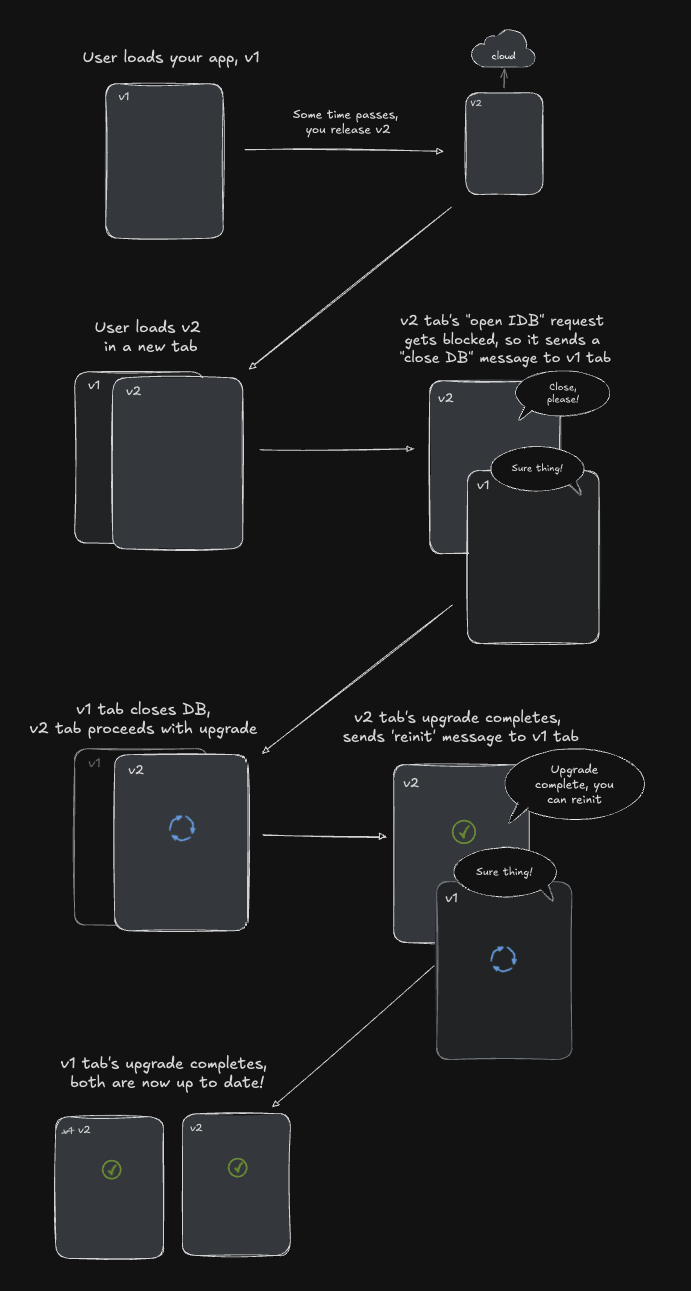
This coordination runs inside the library; you only need to bump version and implement onUpgrade (and optionally onBeforeReinit) for your migrations.